


The effectiveness of internal tank cleaning depends not on a single factor, but on the interaction between plant technology, specialist chemical formulations and effective process management. Only a balanced combination of these elements can deliver reliable, repeatable results that meet demanding quality standards.
While routine cleaning cycles can often be completed through the correct combination of mechanical action, temperature and detergents, more challenging applications require specialist solutions designed to remove difficult contamination, restore internal surfaces and maintain the highest standards of operational safety.
The tank cleaning sector continues to evolve, with operators facing increasingly complex demands.
Reduced downtime, greater process traceability, fewer manual interventions in confined spaces and stricter quality requirements are now key priorities.
In this environment, specialist equipment and the correct choice of cleaning chemicals play a crucial role in achieving successful outcomes.
Tackling persistent latex contamination
Among the most challenging forms of contamination are latex residues. By their nature, these products create persistent deposits that can adhere strongly to the internal walls of tanks and become increasingly difficult to remove over time.
Traditionally, tackling such contamination often required personnel to enter tanks and manually scrape away deposits. This approach increased cleaning times, operating costs and the risks associated with confined-space working.
To address this challenge, OMZ Srl has developed dedicated systems for treating latex-contaminated tanks.
These systems use the continuous recirculation of specialist detergent solutions maintained at controlled temperatures. Combining chemical action, heat and recirculation enables even long-established deposits to be progressively dissolved, eliminating the need for manual intervention inside the tank.
The result is a significant reduction in downtime, together with improved safety and a consistently higher standard of cleaning.
Restoring stainless steel surfaces
Another common challenge involves tanks used to transport temperature-sensitive products, where heating systems are required to maintain product conditions.
After repeated operating cycles, the internal stainless-steel surfaces can develop a characteristic amber discolouration caused by prolonged exposure to elevated temperatures. Although this does not necessarily affect cleanliness, it can negatively influence inspection procedures and pre-loading assessments.
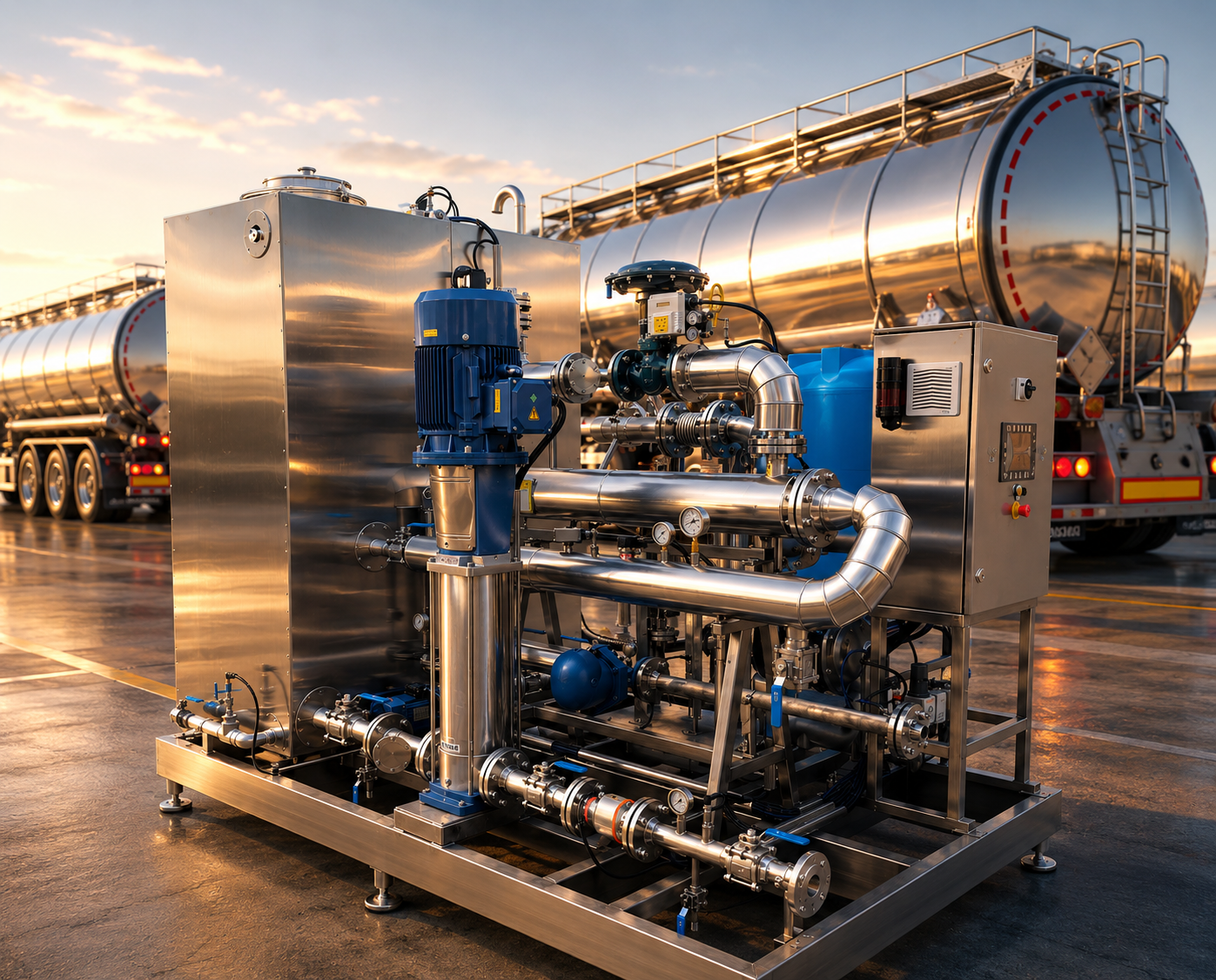
To overcome this issue, OMZ has developed a mobile pickling system that enables closed-loop treatments through the continuous recirculation of dedicated pickling solutions.
The system consists of a stainless-steel wheeled unit equipped with pumps and washing heads designed to distribute the treatment product evenly throughout the tank.
During the process, the liquid is continuously recovered and recirculated, ensuring consistent treatment across all internal surfaces. Following the pickling cycle and a thorough rinse using hot water and alkaline detergent, the tank regains the original appearance of stainless steel, improving both visual presentation and overall container quality.
Safer solvent pre-treatment operations
Pre-treatment with solvents also remains an essential stage in many industrial cleaning applications. In numerous operations, these activities are still carried out using poorly standardised procedures that can lead to inefficiencies and safety concerns.
To address these challenges, OMZ has developed a mobile unit specifically designed for tank pre-treatment using acetone and other solvents. The system allows the process to be carried out under controlled conditions, reducing operator exposure while improving both safety and effectiveness.
Dedicated systems also help improve tank preparation ahead of subsequent washing stages, increasing treatment efficiency and contributing to greater standardisation of operating procedures.
The importance of chemistry
In modern tank cleaning, equipment alone is not enough to achieve reliable and repeatable results. The performance of cleaning chemicals is equally important, particularly in specialist applications involving stubborn contamination or surface restoration.
For this reason, OMZ collaborates with Ma-Fra, an Italian company with more than 60 years of experience in professional chemical formulation and research for industrial cleaning processes.
Together, the companies provide an integrated approach that combines specialist equipment with products selected for specific cleaning challenges.
The partnership brings together OMZ’s engineering expertise and Ma-Fra’s formulation knowledge to develop targeted solutions for the contamination types most commonly encountered in tank cleaning operations.
Each treatment is supported by products from the OMZ-Approved range, developed in collaboration with Ma-Fra laboratories to meet the specific requirements of the internal tank cleaning sector.
Product selection is based on factors such as residue type, tank material and process conditions, helping maximise cleaning performance while optimising treatment times.
Engineering and formulation working together
Today, the integration of engineering expertise and chemical know-how is one of the most important factors in delivering high performance and consistent, repeatable results.
Ma-Fra’s experience in the design, validation and optimisation of specialist formulations helps ensure that every treatment is more effective, safer and easier to reproduce, while fully supporting the capabilities of OMZ’s equipment.
As the industry evolves, increasingly specialised solutions are required to address complex contamination and cleaning processes that extend beyond conventional washing techniques.
The partnership between OMZ and Ma-Fra is founded on the understanding that, in specialist tank treatments, equipment performance and chemical performance must be designed to operate in complete synergy. Only through this integration can operators achieve repeatable results, reduce intervention times and maintain high quality standards, even in the most demanding applications.
Treatments for latex contamination, controlled pickling systems, mobile solvent pre-treatment units and purpose-developed cleaning chemicals demonstrate how technological innovation, applied chemistry and operational safety can work together to improve both efficiency and cleaning quality.
In a market increasingly focused on minimising downtime, protecting personnel and maximising process reliability, the integration of specialist equipment and professional chemical solutions will remain a key factor in meeting the future challenges of the tank cleaning industry.
For more information: Visit www.omzsrl.it and www.mafra.it