


Patrick Stadler, from Chemische Werke Kluthe, and Steven Vos, of Kluthe Benelux, provide a practical overview of HAKUPUR 49-203, CONTROX Latex Remover, the HAKUTEX-series and HAKUPUR 23-64.
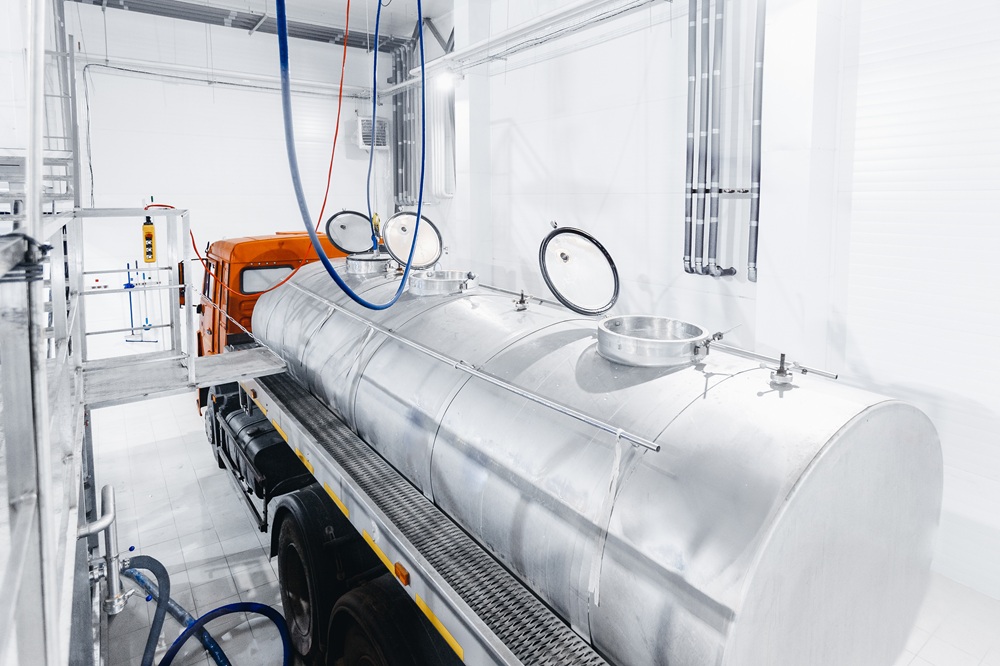
Interior cleaning of tank trucks in the food and raw materials sector is far more than a hygiene task.
It is a critical process for product safety, equipment availability, cost control and the reliable maintenance of quality standards. In practice, operators face a broad range of residues: oils, fats, waxes, fatty acids, latex, resins, polymer-based products, mineral deposits and limescale films.
At the same time, expectations regarding process reliability, reproducibility, documentation, energy efficiency and wastewater management continue to rise.
For operators of tank cleaning facilities, this means one thing: a single “universal product” is generally not enough. What is needed are clearly structured standard processes with cleaners that complement one another, specifically target different types of contamination and can also be integrated safely into day-to-day operations.
That is exactly where the strength of a coordinated product portfolio lies. The different cleaners are designed so they can also be integrated in a practical way into standard wastewater treatment systems such as ultrafiltration or reverse osmosis.
With HAKUPUR 49-203, CONTROX Latex Remover, the HAKUTEX-series and HAKUPUR 23-64, a practical system is available that covers the main requirements of tank and truck interior cleaning.
Together, these products form a toolbox for economical and process-safe cleaning: a food-approved alkaline main cleaner, a specialist for latex residues, a solvent-based cleaner for closed systems and an acidic product for limescale and fatty acids.
Why standardised cleaning processes matter
In modern tank cleaning operations, good results depend on more than chemical performance alone. Effective cleaning always comes from the interaction of chemistry, temperature, concentration, contact time, mechanical action and proper rinsing.
The challenge is to make this process fast, safe and resource-efficient while keeping it robust enough for changing cargoes and contamination profiles. This is especially important in the food and raw materials segment. Residues must not only disappear visually; odour and taste carriers, stubborn films and hard-to-reach deposits must also be removed reliably. Material compatibility, food approval and safe integration into existing wash programmes are equally important.
A commercially viable cleaning concept, therefore, needs clearly defined building blocks: an alkaline standard cleaner for typical organic contamination, a specialist for difficult residues such as latex, a solvent-based option for special cases in closed systems and an acidic cleaner for limescale and fatty acids. This clear role allocation reduces misuse, shortens cleaning times, improves reproducibility and simplifies staff training.
HAKUPUR 49-203: The food-approved alkaline main cleaner
In many tank cleaning processes, HAKUPUR 49-203 is the logical first step. As a food-approved cleaner, it is particularly suitable wherever a high-performance alkaline product with a broad application range is required. Typical residues include oils, fats, waxes, fatty acids and certain resins.
These are exactly the types of contamination often found in food and raw material logistics. In practice, HAKUPUR 49-203 serves as a robust main cleaner for a large share of standard applications. It helps operators standardise processes without switching immediately to special chemistries for every individual load.
That improves process stability and reduces operational complexity. One important economic advantage is its strong cleaning performance at comparatively low use concentration. For operators, this means lower chemical consumption and often lower related costs in rinsing, wastewater treatment and storage. In high-throughput facilities, this can have a measurable impact on overall operating cost. Food approval is another practical benefit.
In facilities with frequently changing cargoes and sensitive applications, a food-approved standard cleaner simplifies release procedures, documentation and training. HAKUPUR 49-203 is, therefore, not just a technically effective alkaline cleaner, but also a strong operational standard product.
CONTROX Latex Remover: Specialist for latex residues
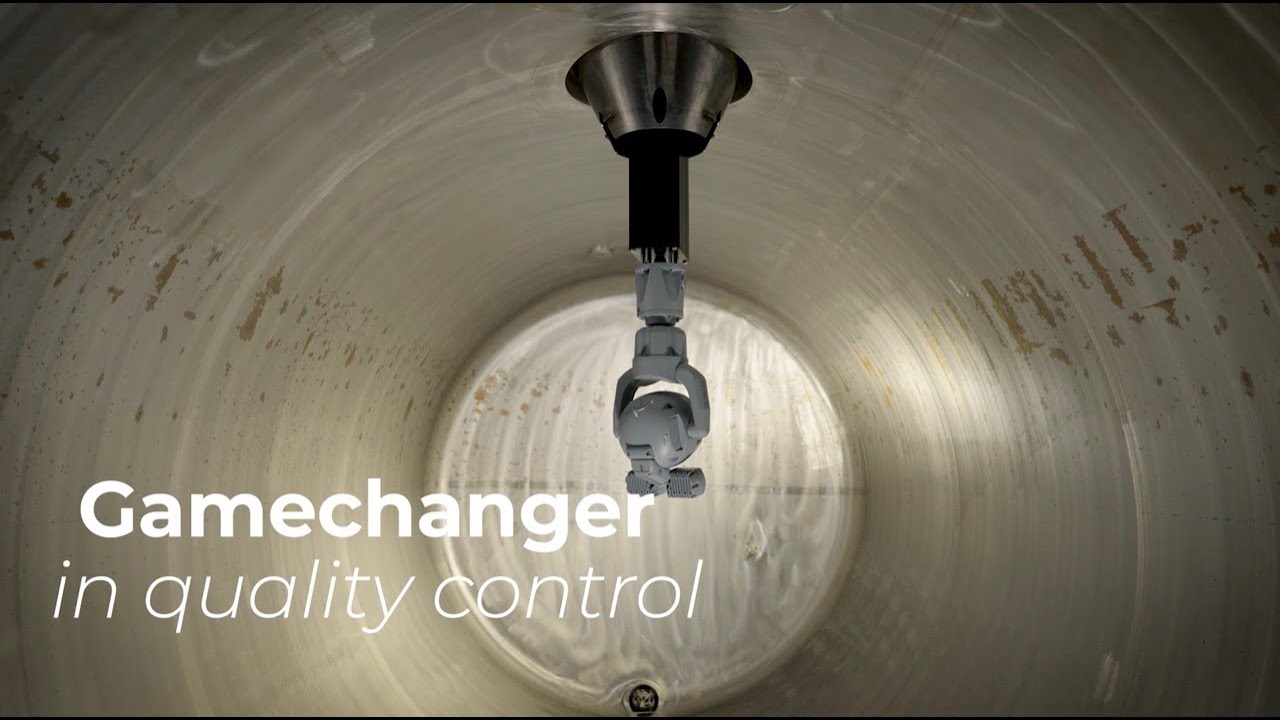
Latex residues are among the most demanding contamination types in tank cleaning. They behave differently from typical oil or grease films and require chemistry specifically designed for this purpose. CONTROX Latex Remover was developed exactly for this kind of task. This product is intended for use in specialised recirculating cleaning systems and is especially effective for latex-contaminated tank trucks.
Where standard cleaners often deliver limited results or require excessive concentration and long cleaning times, CONTROX Latex Remover provides a more controlled and targeted solution. Its economic advantage is particularly relevant in plant operation.
The product is used at a 50% concentration and a prepared 1,000-litre cleaning solution can clean around 100 to 125 tankers, depending on the application. That represents a clear efficiency benefit compared with many competing products that require higher product consumption or more frequent replacement.
Another major advantage is the process logic. The removed latex residues are filtered out within the recirculating system. This means the contamination is not simply redistributed in the cleaning loop, but it is actively separated from it. From a process stability standpoint, this is highly important. Cleaning is typically carried out at around 60°C to 80°C, with cycle times ranging from approximately 45 minutes to several hours, depending on the level of contamination.
The process is then followed by a water rinse. This clearly defined sequence makes standardisation easier and reduces dependency on individual operator experience.
HAKUTEX-series: Solvent-based specialist for closed systems
Not all residues can be removed effectively with water-based standard cleaners. Certain organic contaminants and strongly adhering specialty products require solvent-based treatment. This is the role of the HAKUTEX-series.
The HAKUTEX-series is not designed for open standard cleaning processes. It is intended for defined specialty applications in closed systems, where solvent-based cleaning can be carried out under controlled conditions. This distinction is important because solvent-based processes must be managed with regard to occupational safety, plant safety, emissions and controlled handling. Operationally, the advantage is clear: difficult residues can be treated selectively without changing the entire standard process. HAKUTEX, therefore, acts as a complementary specialist, not as a replacement for alkaline or acidic cleaning. It fills the gap where waterbased products reach their technical or economic limits. In a professional cleaning concept, this role is clearly defined. HAKUPUR 49-203 covers broad alkaline standard cleaning, CONTROX Latex Remover addresses latex residues, HAKUTEX handles selected solvent-based special cases in closed systems and HAKUPUR 23-64 provides the acidic component.
HAKUPUR 23-64: Acidic standard for limescale and fatty acids
Even when alkaline cleaning appears successful, mineral residues often remain a serious issue. Water hardness, temperature and process conditions can lead to limescale films and mixed deposits. These can impair wetting in later cleaning steps, bind odour and taste carriers and gradually affect surfaces and system components.
For this reason, an effective cleaning concept in the food and raw materials sector should always include defined acidic cleaning steps. HAKUPUR 23-64 is the acidic standard in this system. It is a food-approved concentrated cleaner for tanks and storage vessels and is suitable for aluminium and stainless steel. The product removes limescale and fatty acids reliably and, therefore, addresses exactly those residues that often remain after alkaline pre-cleaning or build up over time during operation.
Another practical advantage is its flexibility. HAKUPUR 23-64 can be used at concentrations from 0.5 to 20% in water, depending on the type and severity of contamination. Contact time is typically 5 to 10 minutes, followed by rinsing with water.
For limescale removal in the wash system, 0.5% can be used directly in the system with around 20 minutes contact time at 75°C to 85°C. This broad application range makes HAKUPUR 23-64 suitable both for lighter acidic cleaning and for more intensive descaling. In practice, that means fewer product changes, simpler training and greater process stability. Compared with more aggressive mineral acid blends, it offers a balanced combination of cleaning performance, food approval and material compatibility.
Four clear roles instead of one vague solution
A common mistake in practice is using one cleaner too broadly. The result is often higher dosage, longer cleaning times, lower reproducibility and reduced process safety. A structured product portfolio prevents exactly that.
• HAKUPUR 49-203 serves as the foodapproved alkaline main cleaner for many standard contaminants.
• CONTROX Latex Remover is the specialist for latex residues in recirculating systems.
• The HAKUTEX-series covers solventbased specialty applications in closed systems.
• HAKUPUR 23-64 complements the process as the acidic standard for limescale and fatty acids. This clear division simplifies not only cleaning itself, but also purchasing, storage, training and documentation.
Conclusion
Modern tank and truck interior cleaning requires more than strong chemistry alone. Operators need cleaning processes that are hygienically safe, economical, energy-efficient and reproducible. The answer is not a confusing variety of products, but a focused portfolio with clearly defined roles. With HAKUPUR 49-203, CONTROX Latex Remover, the HAKUTEX-series and HAKUPUR 23-64, such a system is available. Together, these four products create a practical toolbox that reflects real contamination patterns and operational needs: alkaline, latex-specific, solventbased and acidic. That is the basis for stable cleaning results, simpler operations and better cost efficiency in daily practice.
For more information: visit www.kluthe.com